Phone: +86 13034682273
Email: 925673978@qq.com
Work Hours
Monday to Friday: 7AM - 7PM
Weekend: 10AM - 5PM

Work Hours
Monday to Friday: 7AM - 7PM
Weekend: 10AM - 5PM

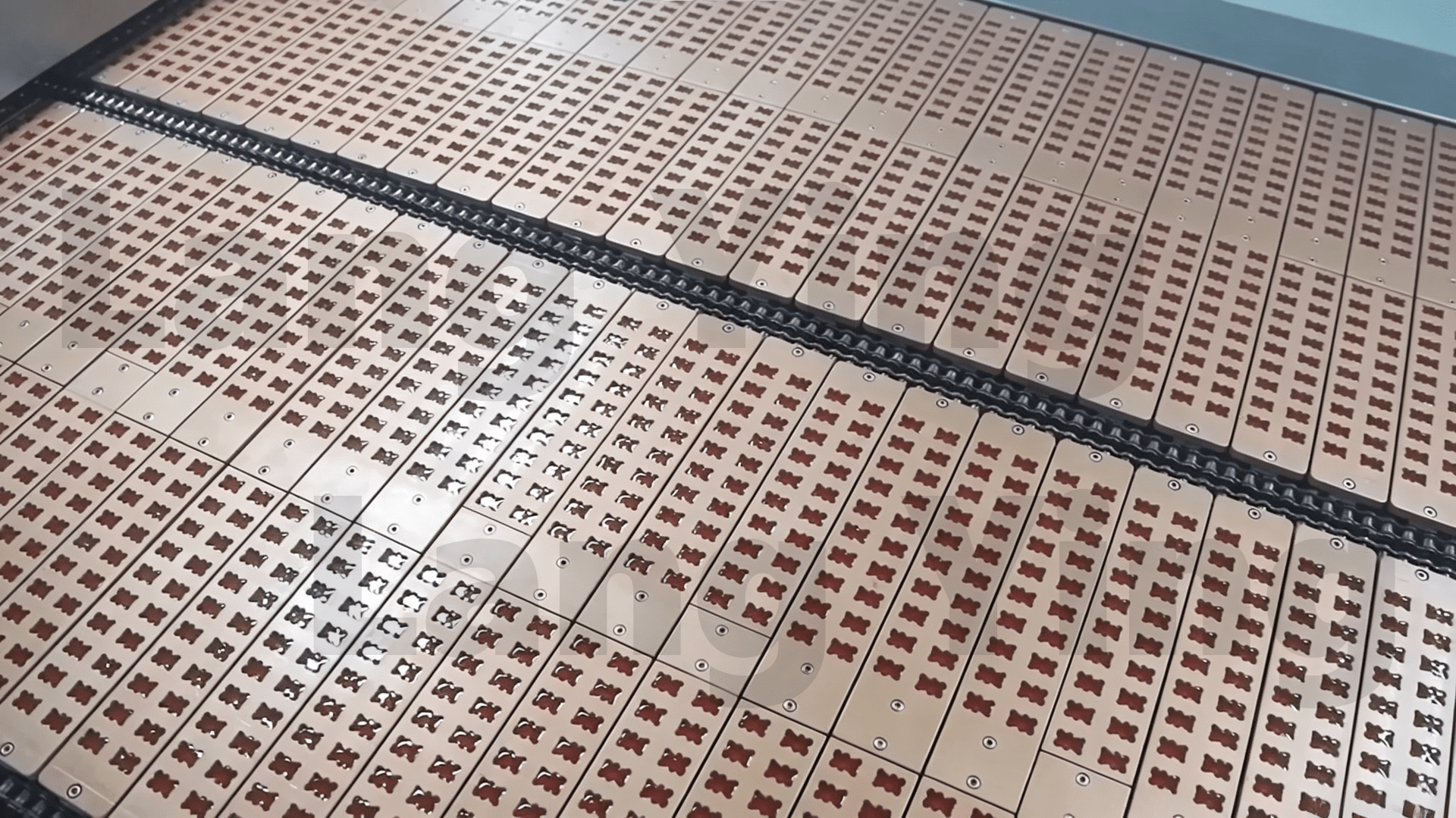
Nutritional gummies have become one of the fastest-growing formats in the health and confectionery space. Consumers expect the same experience they know from traditional candy — a clean bite, a consistent shape, a surface free of defects — while regulators and brand owners demand even higher standards around hygiene, traceability, and dosage uniformity. Behind every well-made gummy sits a piece of equipment that rarely gets the credit it deserves: the mold.
Choosing the right mold material is not a cosmetic decision. It shapes everything from how a batch runs on the line to how the product leaves the packaging. For manufacturers running continuous, high-volume production of vitamin, mineral, and functional gummies, metal molds have emerged as the industry standard — and the reasons go well beyond simple durability.
Food and supplement manufacturers operate under increasingly strict hygiene expectations. Every contaminant that enters a line — every particle, every flake, every shed fragment — is a potential quality issue and a potential recall risk.
Metal molds address this hygiene issue fundamentally at the production source, especially when compared with traditional starch molds widely used in conventional gummy production. Properly finished stainless steel and food-grade alloy cavities do not shed dust, wear into fine particles, or break down into fibrous debris the way softer composite materials and starch molds can. Traditional starch molds are prone to powder shedding and structural crumbling during high-volume production, which easily mixes impurities into nutritional gummies and causes product contamination. In contrast, metal mold surfaces are non-porous and smooth, effectively preventing impurity precipitation and cross-contamination during the molding process. The molds are easy to clean and maintain, providing ultra-sanitary conditions for long-term large-scale nutritional gummy manufacturing.
The payoff is a line that stays cleaner between changeovers, fewer reject batches tied to foreign-matter findings, and a production environment that auditors and quality teams can trust. For brands making gummies positioned around wellness and clean labeling, that cleanliness is not just an internal metric — it is part of the product promise.
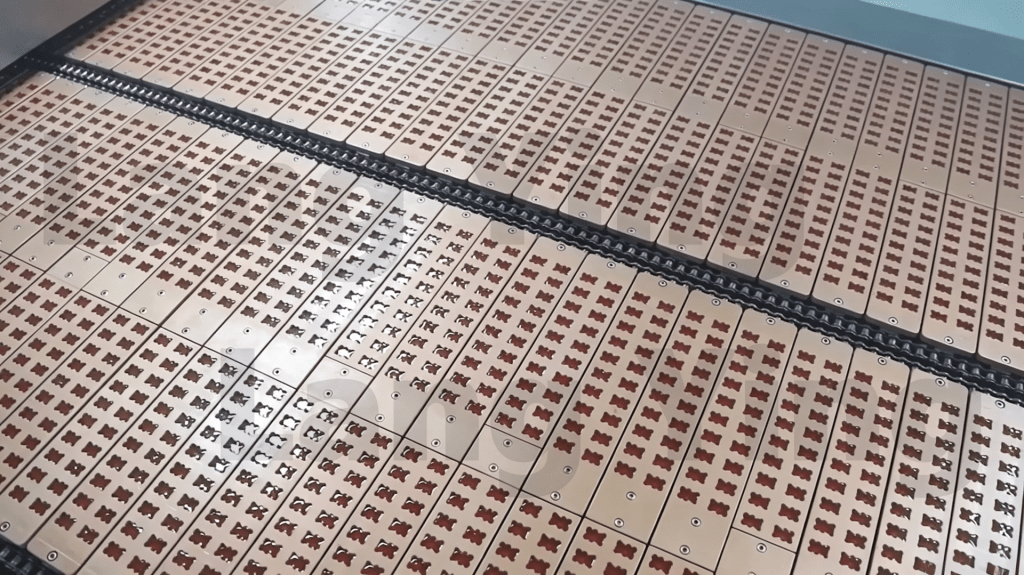
Industrial gummy production is a throughput business. A line that stops, re-tooling, or suffers frequent quality fluctuations costs manufacturers real money at scale.
Thermal behavior is one of the most direct levers here. Gummies leave the depositor warm and must set under controlled, predictable conditions to hold their shape and protect their quality on the line. Metal cavities give manufacturers precise control over how heat moves: they draw warmth out of the gummy mass in a steady, even way and release it predictably to the surrounding cooling air. Compared with traditional starch molds, metal molds achieve a dramatic reduction in cooling duration. The gummies are fully formed right after depositing from the production line. The aim is not to cool as fast as possible for its own sake — rushed cooling can crack the surface, cloud the finish, or spoil texture — but to bring the cooling cycle down substantially while keeping every parameter within the window that protects candy quality. The result is a much shorter cooling time that does not come at the expense of appearance, stability, or taste. It also reduces the defects that appear when gummies are taken off the line before they are ready — sticking, edge distortion, and tacky surfaces all diminish when the product sets under steady, well-controlled conditions.
Beyond cooling, metal molds hold their dimensional precision run after run and resist the repeated thermal cycling inherent in depositing, cooling, and demolding. That stability translates into fewer unscheduled stops, less rework, and a higher yield of conforming product across extended campaigns. The geometry and surface of the cavity also help: a well-designed mold releases each gummy cleanly and uniformly, which reduces sticking and the irregular pieces that slow downstream sorting and packaging. When every piece leaves the cavity within tight tolerances, the rest of the line runs faster, with fewer interruptions and less manual intervention.
That release performance is where specialist tooling really earns its place. Manufacturers who design and build confectionery molds for a living — Langying Molds is one such example — refine cavity geometry, draft angles, and surface treatments specifically for gummy deposition. As a professional manufacturer specializing in custom design and production of candy molds, Langying Molds adopts independently developed food-grade non-stick coating for mold cavities. The coating complies with strict food contact safety standards, featuring stable safety performance and excellent demolding properties. It enables smooth, residue-free gummy release without damaging the product surface, effectively reducing production defects and optimizing the overall production process for large-scale gummy factories.
Today’s nutritional gummies are not generic blobs. Brands compete on shelf appeal, and a gummy’s shape is often the first signal of quality a consumer touches. Animal forms, characters, embossed logos, custom icons, and finely detailed surface textures all carry expectations that only precision tooling can meet.
Metal molds reproduce detail that softer mold surfaces simply cannot sustain. Fine lines, delicate edges, embossed lettering, and complex multi-part forms hold their definition across very long production runs because the mold itself does not deform or soften in service. The result is a product that looks as intended at the start of a run and long into it — a level of visual consistency that protects brand recognition and reduces the subtle, creeping drift in appearance that erodes consumer trust over time.
This matters beyond aesthetics. For nutritional products, consistent size and shape also support more uniform weight control and dosing across batches, which is a core requirement in supplement manufacturing.
These efficiency and quality gains also compound into better long-term value. Metal molds serve far longer than less durable alternatives, so the cost of producing each piece falls as a campaign runs on, and less material and energy go into repeated mold replacement and disposal. For manufacturers weighing true total cost of ownership rather than just purchase price, that durability creates outstanding long-term comprehensive benefits, greatly reducing comprehensive production costs for continuous mass production.
The environmental case runs in parallel. At the end of a mold’s long service life, the high-quality metal alloy material is fully recyclable. This recyclable characteristic minimizes industrial waste output, avoids resource waste caused by frequent mold replacement, and perfectly fits the green, environmentally sustainable development concepts that global food manufacturing enterprises are actively practicing. It helps candy and nutritional gummy manufacturers build eco-friendly production systems while stabilizing production quality and efficiency.
It is easy to evaluate molds on a per-unit cost basis, but that view misses how the decision compounds. A mold that sheds particles creates quality risk. A mold that offers no thermal control drags out cycle times and caps throughput. A mold that drifts in geometry creates yield loss. A mold that cannot hold fine detail limits what a brand can design and how it can differentiate.
Metal molds resolve all of these concerns at once. They deliver a dust-free, hygienic cavity with no hidden contamination risks and zero impurity mixing compared with traditional starch molds; they give precise thermal control that shortens cooling without compromising candy quality; they keep fast, stable production running longer with fewer interruptions; they reproduce intricate, brand-defining detail batch after batch; and their long service life and recyclable material support both the bottom line and environmental goals. For manufacturers investing in nutritional gummy capacity — whether producing under private label, contract manufacturing, or their own brand — the mold is one of the few pieces of equipment whose influence touches product quality, production efficiency, cost, and brand image simultaneously.
The most successful gummy producers treat their molds not as consumables, but as precision production assets. Choosing tooling built for those standards — from specialist manufacturers who understand depositing lines, food-contact safety, GMP environments, and long-run consistency — is what separates a reliable, scalable product from one that spends its life on the quality team’s watchlist.